Viral Immunotherapy Offers Hope Beyond Glioblastoma Diagnosis
In December 2021, Kyle Donohue reached a fork in the road. Kyle had been diagnosed with glioblastoma, an aggressive form of brain cancer, less than a year before and, although surgery to remove the tumor had been successful, an MRI showed signs that the cancer had come back.
Kyle and her husband Jim had tried to stay positive throughout Kyle’s diagnosis and treatment, but after taking a step back to look at the big picture, she experienced a rare moment of profound sadness.
“I wanted to see my kids graduate from high school, from college, start relationships, get married. I wanted to be there for those moments,” she said. “I was just so sad to think I wouldn’t be able to have those experiences.”
The next morning, Kyle received a phone call from E. Antonio “Nino” Chiocca, MD, PhD, the Mass General Brigham neurosurgeon who removed her tumor.
“He told me he had one spot left in his viral immunotherapy clinical trial,” Kyle remembered. Kyle enrolled in the clinical trial, unsure of where this path would lead her.
The concept of enlisting the help of a virus to treat cancer isn’t new. As early as the 19th century, physicians reported cases of cancer patients going into remission following a viral infection.
But the field is reaching a critical turning point as clinical trials reveal how this unique form of immunotherapy — which seeks to harness the destructive power of viruses to both kill cancer cells and alert the body’s immune system to the presence of cancer — could lead to better treatments for patients like Kyle.
Turning up the temperature on a ‘cold’ tumor
Glioblastoma (GBM) is a notoriously resistant and recurrent cancer. Most GBM patients will experience a recurrence within 6 to 12 months after their initial treatment. On average, the overall survival time is about 15 months.
Immunotherapies, which rev up the body’s immune system to better fight cancer, have not been effective against GBM, in part because of the tumor microenvironment, the milieu of cells and signaling molecules surrounding the tumor, which are profoundly immunosuppressive.
But oncolytic viral therapy may have the ability to turn these “cold” or “immune-deserted” tumors into hotbeds for immune activity by shifting the tumor microenvironment.
“Most people think of viruses as pathogenic microorganisms that infect cells, but our research efforts focus on an old hypothesis that viruses can be used to kill tumor cells,” said Chiocca, who is the executive director for the Center for Tumors of the Nervous System at Mass General Brigham Cancer Institute and Chair of the Department of Neurosurgery. “We’ve reached an exciting inflection point and are translating our scientific findings into clinical trials.”
Cheering for a virus
Chiocca’s clinical trial represents the culmination of decades of research at Brigham and Women’s Hospital in collaboration with Dana-Farber Cancer Institute.
Using DNA engineered in the lab, researchers have built specialized, recombinant herpes viruses that are harmless to healthy brain cells and instead infect only tumor cells, replicating within them and then destroying them. In the process, they release signaling molecules that can ignite immune defenses.
The phase 1 trial that Kyle enrolled in had 41 participants and was designed to evaluate an engineered oncolytic virus’s safety and efficacy.
“When Dr. Chiocca told us he’d be using the herpes virus, we joked that we’d been trying to stay away from herpes our whole life,” Kyle’s husband Jim recalled. “And now, we were cheering for herpes.”
Kyle’s clinical trial treatment lasted a week. At times, it was grueling, including seven hours of chemotherapy infusion and an injection of the engineered virus directly into her tumor. Her results, however, were dramatic. Kyle’s recurrent cancer shrank and, most importantly, it hasn’t come back.
“We didn’t know what the long-term outcome would be,” said Kyle, who is now entering her sixth year since being diagnosed with glioblastoma. “But having improvements that are measured by months and then years, that’s hugely significant.”
The engineered oncolytic virus used in the trial, known as CAN-3110, has now been licensed to Candel Therapeutics, Inc.
Improving understanding to improve treatment
Not all patients have responded as well to the viral immunotherapy treatment as Kyle, and Chiocca and his colleagues want to know why.
In a paper published in Science Translational Medicine, they showed that tumor samples could help detect whether the immune system was being activated.
Joshua Bernstock MD, PhD, of Mass General Brigham Neuroscience Institute, recently co-authored a review paper that takes a deeper look into the interplay between oncolytic viruses and the tumor microenvironment.
“One of the great strengths of Mass General Brigham is that our cancer and neuroscience experts work within the same system, sharing ideas across disciplines in real time,” said Bernstock. “That collaboration, combined with what we’re learning through clinical trials and from our patients, can help us accelerate discovery.”
New horizons
Glioblastoma has taken its toll on Kyle and her family. She lost her memory completely for almost 8 weeks before the tumor was removed, and it took a long time for her to regain it.
But many things have returned to Kyle — her memory, much of her physical activity, and her ability to paint, which she does as a hobby. And she’s been able to be there for many of the big moments in life that she had thought she would miss. Some are sweet, others poignant, like the death of both of her parents.
“All of those things, those wonderful things, and even some of the bad ones, we were there, Kyle was there, every step of the way,” said Jim.
Today, Kyle paints seascapes, which she sells to raise money for future cancer research clinical trials.
“There’s so much research being done about new treatments,” said Kyle. “And the work that’s being done, it matters. The clinical trial was a lifesaver for me. I feel so lucky to have benefited from it.”
Immune cells in glioblastoma after treatment with intracranial CAN3110
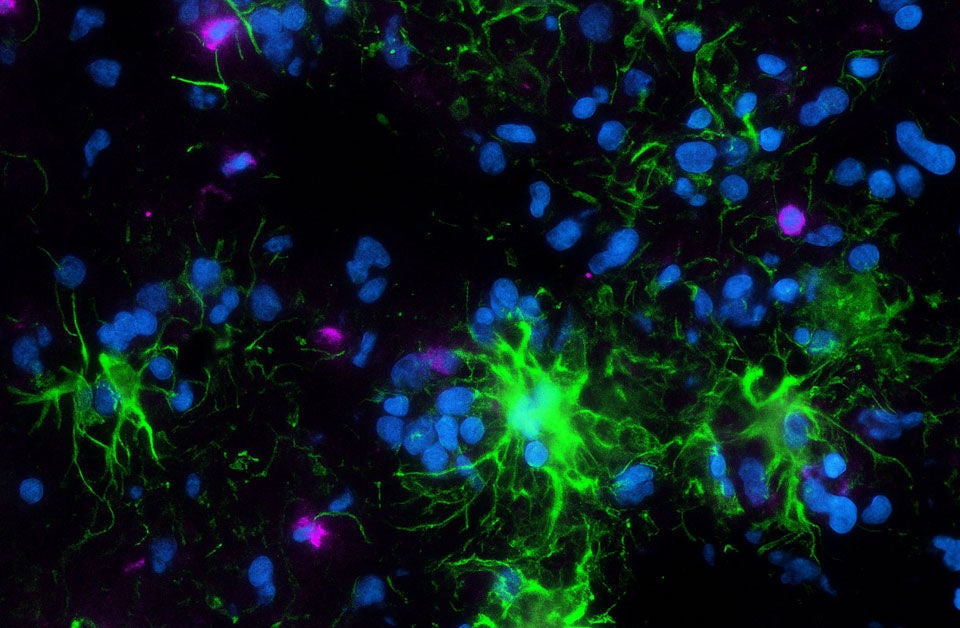
This image shows how immune cells behave in glioblastoma after treatment with intracranial CAN3110. The blue color marks cell nuclei, green highlights PDL1-positive myeloid cells, and pink shows CD8-positive T cells.
Read the paper
Serial multiomics uncovers anti-glioblastoma responses not evident by routine clinical analyses
About Mass General Brigham
Mass General Brigham is an integrated academic health care system, uniting great minds to solve the hardest problems in medicine for our communities and the world. Mass General Brigham connects a full continuum of care across a system of academic medical centers, community and specialty hospitals, a health insurance plan, physician networks, community health centers, home care, and long-term care services. Mass General Brigham is a nonprofit organization committed to patient care, research, teaching, and service to the community. In addition, Mass General Brigham is one of the nation’s leading biomedical research organizations with several Harvard Medical School teaching hospitals. For more information, please visit massgeneralbrigham.org.