Five things to know: What Mass General Brigham experts had to say about cardiovascular care at the 2026 World Medical Innovation Forum
The 2026 World Medical Innovation Forum (WMIF)brought together leading physicians, scientists, investors and policymakers for two days in September to debrief on cutting-edge medical innovation across different fields and expertise. Cardiovascular disease, a leading cause of death worldwide, took center stage as three experts from the Heart and Vascular Instituteat Mass General Brigham joined a panel to discuss emerging treatments in cardiovascular medicine.
Grounded in both rigorous research and clinical practice, Emily Lau, MD, MPH, co-director of the Women’s Heart Health Program, Jorge Plutzky, MD, director of Preventive Cardiology and Christian Ruff, MD, MPH, director of Cardiovascular Medicine AMC Clinical Operations, explored the last decade of progress in cardiovascular treatment and shared where the field is heading next. From new medical strategies, women’s cardiovascular health and even a recent clinical trial that missed its endpoint goal, they touched on a wide range of issues pertinent to cardiovascular care today.
Here, we’ve compiled the top five takeaways from their insightful discussion:
1. Cardiovascular treatment has come a long way in the past decade.
The identification of key cardiovascular disease drivers and biomarkers has shaped what treatment looks like today. Lipid-lowering therapies, such as statins, ezetimibe and more recently PCSK9 inhibitors, have been broadly established as first-line treatments.
Recognizing the importance of “lowering atherogenic lipoproteins as aggressively as possible and as early as possible,” Ruff said, “has been a foundational advance.” This stems from an improved understanding of how atherogenic lipoproteins — cholesterol and lipid-carrying particles, including low-density lipoprotein (LDL) cholesterol, that can accumulate as artery-clogging plaques — lead to various forms of cardiovascular disease.
The last decade has also seen the field move toward earlier intervention rather than waiting for serious symptoms to appear. According to Lau, people should begin to think about keeping LDL levels low as early as adolescence, as outcomes can be influenced by lifestyle habits.
2. With therapies like GLP-1s, the emerging standard of cardiometabolic care takes a precision medicine approach that addresses overall risk.
Lowering individual disease drivers like LDL cholesterol or blood pressure is a common first course of action, but it doesn’t always solve the whole problem: patients can have a complex constellation of interconnected risk factors affecting their overall cardiometabolic health. This creates residual risk that remains even after successful treatment with lipid-lowering therapies.
The experts noted that patients tend to fall within distinct groups of cardiometabolic phenotypes, and that correctly identifying these phenotypes is key for effective personalized treatment.
The rapidly growing class of incretin therapies like GLP-1s is poised to revolutionize treatment for certain phenotypes by addressing overall risk. By simultaneously mitigating multiple drivers of cardiometabolic disease, including obesity and diabetes, GLP-1s have been shown to effectively reduce harmful cardiovascular events like heart failure and atherosclerosis. Plutzky, who has been involved in GLP-1 clinical trials, called this a “seismic change” in treatment.
3. Lipoprotein(a) has been established as a key risk factor for cardiovascular disease. Its causal link is unconfirmed, but not yet refuted, despite recent clinical results.
Lipoprotein(a) – Lp(a) for short – has come into focus as an important cardiovascular biomarker that, unlike LDL cholesterol, is 90% heritable and remains mostly stable throughout one’s life. Lau said that newly updated guidelines recommend patients be screened for their Lpa(a) level at least once in their lifetimes.
Recently, neutral clinical trial results for an Lp(a)-lowering therapy challenged the widely held notion that high Lp(a) levels play a causal role in cardiovascular disease; despite successfully lowering Lp(a), the treatment did not improve cardiovascular outcomes in the trial.
Many questions remain, however, and results should be interpreted with consideration of the many factors that can shape clinical trial outcomes. “This certainly was a surprising result,” Plutzky acknowledged. “It doesn’t obviate the extensive evidence that Lp(a) is highly predictive of cardiovascular risk.”
There are also other Lp(a)-lowering therapies in development that function differently and may prove to be more effective. “We need to dig further and understand it more before we give up on the concept,” Ruff said.
4. Women’s cardiovascular health is inextricably tied to reproductive milestones and should be monitored across their lifetime.
Emerging data pinpoints reproductive milestones in a woman’s life – including menarche (one’s first period), pregnancy, and menopause – as “inflection points” or “stress tests” for cardiovascular health, Lau said.
For example, Lp(a) levels, thought to be generally stable, have been shown to increase during menopause. This raises questions about current once-a-lifetime Lp(a) screening guidelines. According to Lau, if a woman has intermediate levels of Lp(a) prior to menopause, it could make sense for her to get her levels measured again after menopause to “more precisely refine her risk assessment.”
Overall, Lau emphasized the need to paint an “integrated picture of risk factors across the entire life course,” particularly for women. “What we haven't done as a field yet is marry our preventive strategy with these important transition points,” she said.
5. The next frontiers of cardiovascular medicine are prevention and implementation.
Cardiovascular treatment is moving upstream, seeking to control all known risk factors long before the onset of disease and attempting to solve recurrent cardiovascular events. “It’s a cumulative burden,” said Ruff, “so the earlier you identify at-risk patients, the more impact you will have.”
The next challenge is ensuring all eligible patients benefit from the progress that has already been achieved. According to Plutzky, supporting internists in prescribing the right cardiometabolic medications for the right patients is one strategy that could help make current treatments more accessible. The experts emphasized this focus on effective implementation — the actual delivery of care to more patients — will be critical for improving population-level outcomes both now and as new therapies become available.
“As cardiologists, we’re so proud to be in the space of cardiovascular science,” said Lau. “We're so lucky to have so much evidence to really help guide our treatment and care of patients.”
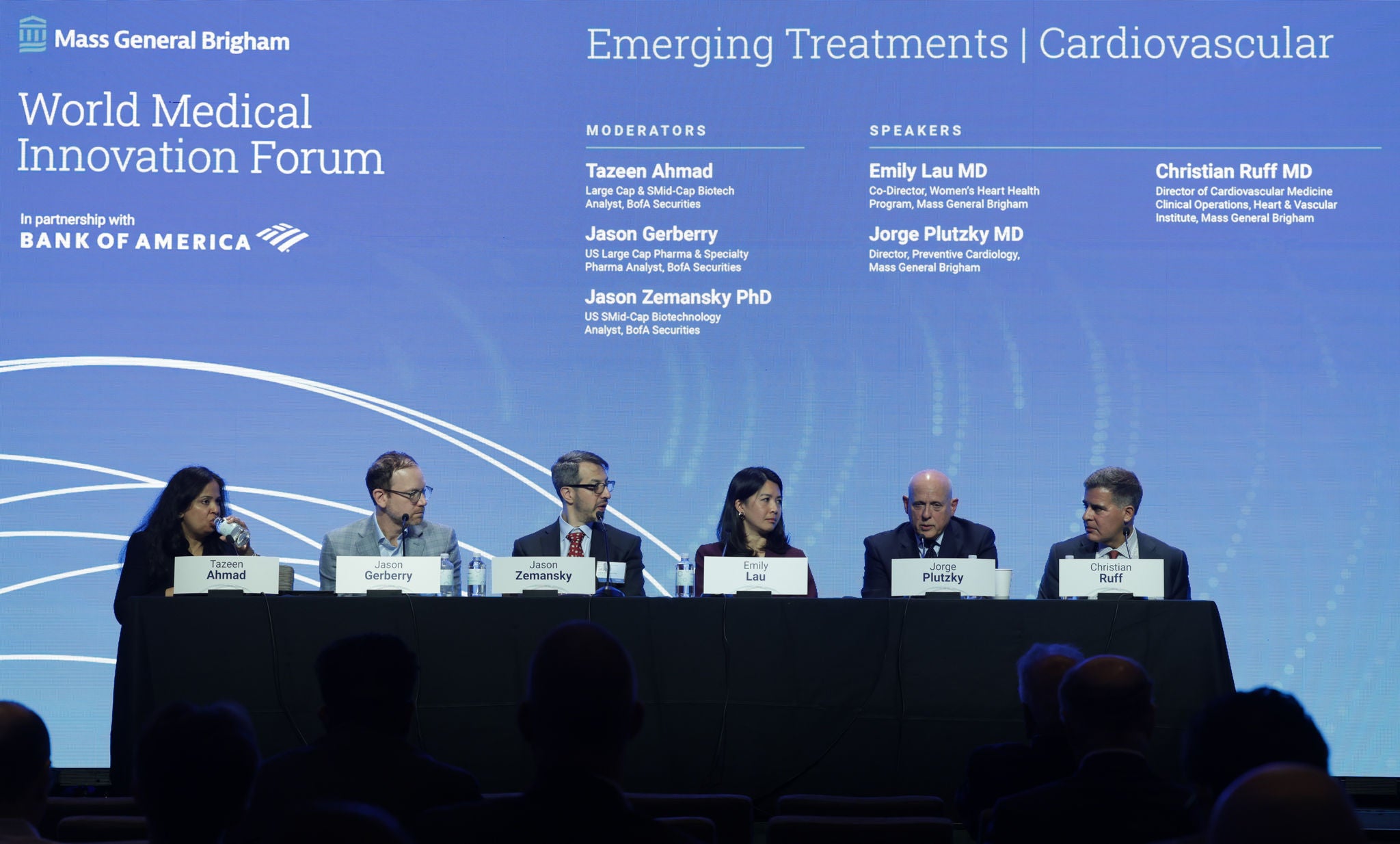
Participants in the Emerging Treatments | Cardiovascular session at the World Medical Innovation Forum, from left: Tazeen Ahmad, BofA Securities; Jason Gerberry, BofA Securities; Jason Zemansky, PhD, BofA Securities; Emily Lau, MD, Mass General Brigham; Jorge Plutzky, MD, Mass General Brigham; and Christian Ruff, MD, Mass General Brigham.
Learn more about the 2026 World Medical Innovation Forum
About Mass General Brigham
Mass General Brigham is an integrated academic health care system, uniting great minds to solve the hardest problems in medicine for our communities and the world. Mass General Brigham connects a full continuum of care across a system of academic medical centers, community and specialty hospitals, a health insurance plan, physician networks, community health centers, home care, and long-term care services. Mass General Brigham is a nonprofit organization committed to patient care, research, teaching, and service to the community. In addition, Mass General Brigham is one of the nation’s leading biomedical research organizations with several Harvard Medical School teaching hospitals. For more information, please visit massgeneralbrigham.org.