Wentworth-Douglass Hospital expands access to advanced cardiac care
For an 81-year-old patient, everyday activity had become increasingly difficult. Chest pain and shortness of breath persisted when he exerted himself and these symptoms didn’t subside with medications. A stress test suggested that blood flow to his heart might be restricted.
That test result brought him to Rodrigo Mendirichaga, MD, an interventional cardiologist at Wentworth-Douglass Hospital in Dover, NH, and medical director of the hospital’s Center for Heart Health within the Mass General Brigham Heart and Vascular Institute. Mendirichaga performed a cardiac catheterization that revealed the extent of the problem: severe blockages in several coronary arteries, including a heavily calcified, severe narrowing in the left main coronary artery.
“This was serious disease at a critical point in his coronary arteries,” Mendirichaga said. “For somebody younger, open-heart surgery would be the likely course — a bypass procedure to create a new path for blood to travel around narrowed arteries.”
But the patient’s age and other medical conditions made him a suboptimal candidate for surgery. Surgery also would come with a longer, more difficult recovery than other potential treatment options.
“The patient was not interested in open-heart surgery. He wanted to be treated percutaneously if we could offer that for him and he wanted it done locally,” Mendirichaga said. “The next question for us became, is this something we can offer here or is this something best suited for our academic medical centers in Boston?”
The Wentworth-Douglass team focused on an atherectomy-assisted, multi-vessel percutaneous coronary intervention (PCI), supported by an Impella device, as the best alternative to surgery. During a PCI, physicians guide small tubes through an artery to the heart and use specialized tools and stents to reopen narrowed vessels. Impella is a mechanical circulatory support device inserted through an artery in the groin. The device temporarily helps the heart pump blood while physicians treat complex blockages.
Until this point, Wentworth-Douglass had only performed Impella-supported procedures in emergencies. This would be the first staged Impella-supported complex PCI on an outpatient at Wentworth-Douglass and the first time the procedure would be performed electively outside of one of Mass General Brigham’s academic medical centers.
After months of preparation, Mendirichaga and team safely and successfully performed the procedure this past July at Wentworth-Douglass, deploying multiple stents to restore blood flow through the principal vessels supplying the patient's heart. The patient was discharged from the hospital the following day and recovered well.
“This case represents much more than a single procedure,” Mendirichaga said. “It reflects what can be accomplished through multidisciplinary collaboration and a shared commitment to expanding access to advanced cardiovascular care close to home for our patients.”
Making of a milestone
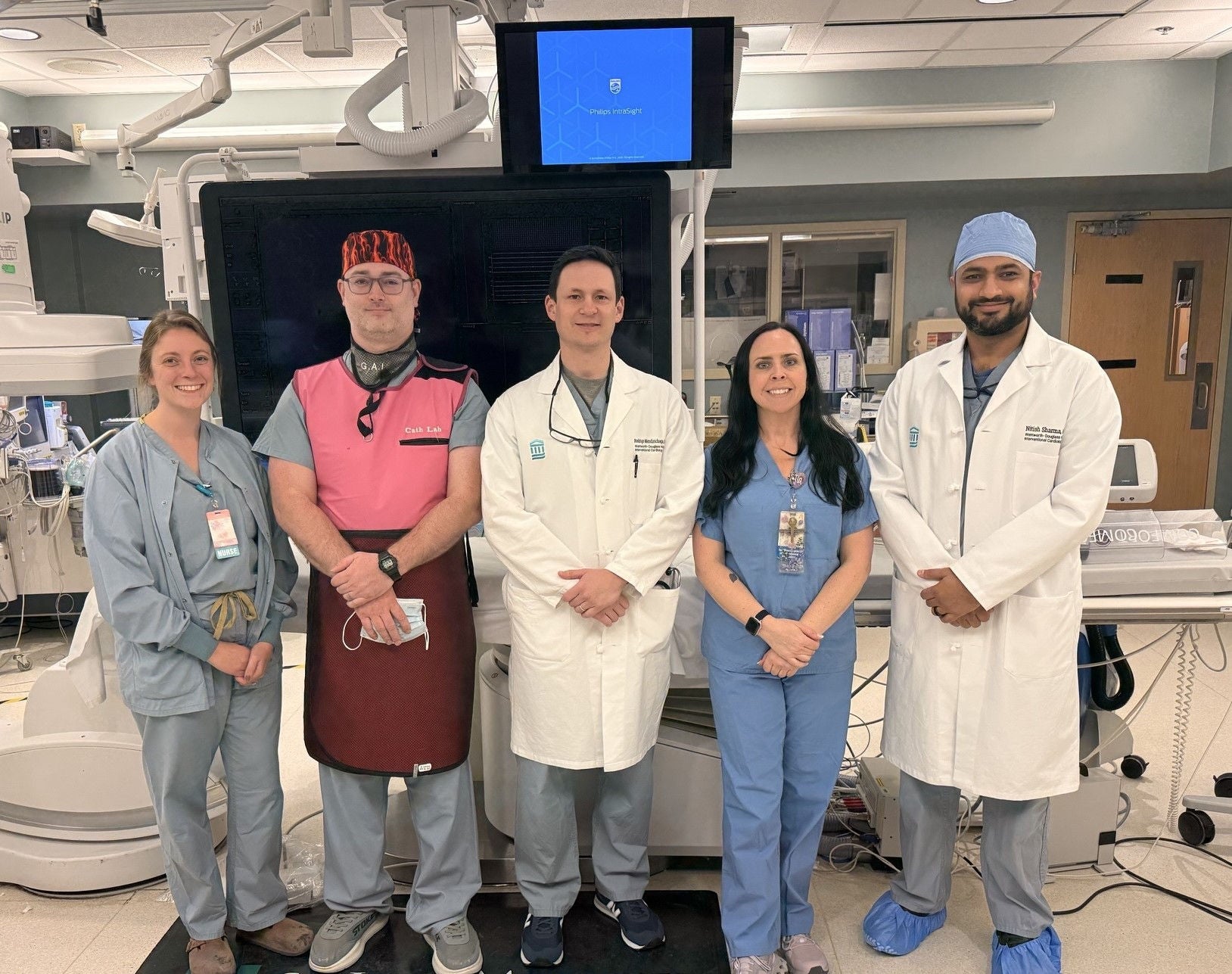
To prepare for the procedure, Mendirichaga and Wentworth-Douglass’s Cath Lab team developed a coordinated plan involving colleagues across interventional cardiology, anesthesiology, the intensive care unit (ICU) and vascular surgery. Anesthesiology supported the patient during the procedure, and vascular surgery was prepared to assist should any complications have arisen where the Impella device was inserted. The ICU team provided post-procedure care and aided the patient’s quick recovery.
“Every single piece of the puzzle had to be in place,” Mendirichaga said. “The planning, coordination, expertise and commitment from every member of the team were essential to making this case a success.”
The procedure is another example of the advanced cardiac care that Mass General Brigham’s Heart and Vascular Institute and Wentworth-Douglass are bringing to patients in the Seacoast communities of New Hampshire and southern Maine. Earlier this year, Wentworth-Douglass, along with Salem Hospital, launched atrial fibrillation (A-fib) ablation programs to provide high-level care that previously required a trip to Boston and one of Mass General Brigham’s academic medical centers.
“This milestone reflects the strength of the cardiovascular team we are building at Wentworth-Douglass and our commitment to bringing advanced, high-quality care closer to where our patients live,” said Mike Mazzini, MD, chief of Community Cardiology for Mass General Brigham. “The growth of our interventional cardiology program and the expertise of Drs. Mendirichaga, Gregory Imbrie and Nitish Sharma demonstrate what is possible when we combine outstanding local clinical teams with the capabilities and resources of Mass General Brigham and our Heart and Vascular Institute.”
The procedure creates the opportunity for Wentworth-Douglass to consider similar elective treatment for carefully selected patients.
“The new capability gives us another potential option when the patient’s needs and the hospital’s resources and expertise align,” Mendirichaga said. “We’re able to deliver world-class care while enhancing accessibility and convenience for our patients.”