Q&A With Dr. E. Antonio Chiocca: Can Combining Oncolytic and Peptide Vaccines Hold the Key to Treating Glioblastoma?
Key takeaways
- Glioblastoma is a notoriously resistant and recurrent cancer with an overall survival time of about 15 months.
- Immunotherapies have not been effective against glioblastoma, partly because the tumor microenvironment is profoundly immunosuppressive.
- Mass General Brigham neurosurgeon E. Antonio Chiocca, MD, PhD, is part of a research team that received a $12.5 million grant to launch a clinical trial that combines an oncolytic vaccine and a peptide vaccine to advance glioblastoma treatment.
Mass General Brigham neurosurgeon E. Antonio Chiocca, MD, PhD, was recently awarded a $12.5 million grant from the National Cancer Institute (NCI) to support his research project, Understanding and Overcoming T Cell Immunosuppression in Glioblastoma. The multidisciplinary effort involves investigators from Mass General Brigham, Harvard Medical School, the Broad Institute, and Dana-Farber Cancer Institute.
The new funding will support the launch of a clinical trial that pairs an oncolytic vaccine developed at Mass General Brigham with a personalized peptide vaccine created at Dana-Farber. The goal is to elicit a more personalized and effective immune response that can better recognize and attack glioblastoma cells.
Dr. Chiocca, a nationally recognized leader in neuro-oncology, is the executive director for the Center for Tumors of the Nervous System at Mass General Brigham Cancer Institute and chair of the Department of Neurosurgery.
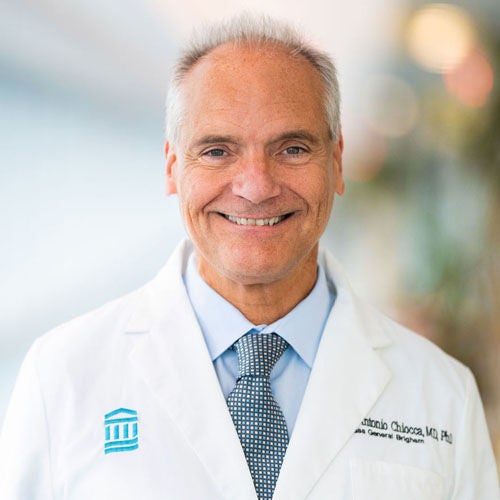
E. Antonio Chiocca, MD, PhD
Q: What’s your reaction to receiving this prestigious grant?
Chiocca: First of all, I’m very grateful. Getting large awards from the NCI and the NIH (National Institutes of Health) is always a challenge because you’re competing against scientists and clinician-scientists across the country. But I’m just a name on the grant. This was a two-year process that involved contributions from a team of superstars from across four institutions.
Q: At a high level, what do you hope to achieve through this grant?
Chiocca: Recurrent glioblastoma is probably the worst cancer to have right now. The median recurrence for these tumors is five to six months. Whereas there has been some progress in treating cancers like pancreatic cancer, we still have no answers for glioblastoma; most of the therapies available today are palliative. With this grant and the clinical trial, we’re hoping to figure out how to improve the treatment options for what is a desperate group of patients.
Q: Why have cancer-fighting T cells and immunotherapies had such limited effectiveness in treating glioblastoma?
Chiocca: Immune checkpoint inhibitors like pembrolizumab and nivolumab have worked well for melanoma, lung cancer, kidney cancer, and other cancers but have failed miserably with glioblastoma. The problem is that glioblastoma is a prototypically “cold” tumor. That is, T cells generally do not penetrate the tumor. And those few T cells that do get in do not persist. You need to have T cells penetrate the tumor, recognize the tumor antigen, and kill off the tumor cells to get an effective anticancer response.
So, the entire premise of our grant was, how can we get more T cells into the tumor? How can we get them to persist in a durable manner? From our previous studies, we’ve seen that our oncolytic vaccine can do this. It basically changes glioblastoma from a “cold” to a “hot” tumor, allowing an extremely high number of T cells to penetrate and infiltrate the tumor. And not only do they come in, but they become activated and persist. We found that even three years after injection, T cells are persisting in the tumor and actively killing tumor cells.
We believe that oncolytic viral vaccines represent a great modality to overcome that immunosuppressive microenvironment. And by coupling the oncolytic vaccine with a peptide vaccine, we can also tell those T cells to come in and kill those tumor cells that express the antigens to which the patient has been vaccinated against. That will give a little more specificity to the T cell response.
Q: Tell me about your team’s previous work that led to this grant.
Chiocca: This work will fund a continuation of work covered by a grant that ran from 2020 to 2025. During that period, we ran clinical trials involving recurrent glioblastoma in parallel. One trial looked at a personalized peptide vaccine in which the patient’s own tumor peptides were used to create a vaccine to fight the glioblastoma. For the second trial, we studied samples from a separate trial and injected a tumor-specific oncolytic vaccine based on a virus. That stimulated a strong immune response.
Through our research, we found that together, the two types of vaccines can have a synergistic effect. A tissue analysis showed that these oncolytic vaccines stimulate or change the tumor microenvironment so that T cells that attack tumor antigens are more apt to come in, persist, and continue to kill tumor cells that express these tumor antigens. Now if we vaccinate the patient with the tumor antigens, then we expect to increase even further the immune rejection of tumor cells.
So, we saw a clear scientific rationale for putting these two types of vaccines together. That’s the hypothesis we’re testing in this new grant and new trial: whether the potential synergy that we see at the scientific level will translate into therapeutic benefit in patients.
Q: What went into the development of the oncolytic vaccine at Mass General Brigham?
Chiocca: We first made the vaccine in my lab in the early 2000s. It was modified from herpes simplex virus (HSV) type 1. We genetically engineered it to attack and kill glioma cells, or tumor cells in general. That is, it won’t kill off normal cells in the body—in the brain, that would be neurons, astrocytes, and glial cells. It’s very specific for tumor cells. Essentially, it involved using promoter and enhancer sequences that are expressed in glioblastoma but not in normal tissues.
After unsuccessfully pursuing other means of funding, we developed the vaccine with funding from the NIH, foundations like the Alliance for Cancer Gene Therapy, and philanthropy to do Investigational New Drug–enabling studies. Getting those studies done took about 10 years. Once we finished those, we were finally able to treat the first patient. Over the past eight years, we’ve treated more than 60 patients with glioblastoma.
Q: In parallel with the new clinical trial, your team will conduct detailed analyses of patient tumors to identify biomarkers that may predict treatment response and provide early evidence of efficacy. Tell me about that work.
Chiocca: One of the things we want to do in this clinical trial is to identify the immunologic and biologic biomarkers of response. In the previous trial with the peptide vaccine, not surprisingly, we saw that the best responders were those who had T cell activation against the peptide vaccine that they were vaccinated against. With the oncolytic vaccine trial, our collaborators in this grant saw that the best biomarker responses were in those who had T cells expand once they entered the tumor. When T cells encounter their target tumor antigen, they will expand. These expanded T cell clones can go on and kill tumor cells. We found that this clonotype T cell expansion was positively and significantly associated with survivorship.
Additionally, our collaborators in the grant showed that you could measure the T cells’ proximity to tumor cells and that the closer those T cells were, the better the survivorship was. So, these are all indications of T cell function in the tissues that we analyze that are associated with a response. Now, we want to figure out the biomarkers’ response—if we combine these two trials, can we show that this happens even more so when you put these two therapies together?
Q: Could you share more about the multi-institutional team working on this grant?
Chiocca: This trial involves neurosurgery; that’s my area of expertise. It involves medical oncology; that’s where my long-time collaborator, David Reardon at Dana-Farber, comes in. Katherine Wu and Kai Wucherpfennig, also at Dana-Farber, are involved with the tumor immunology component. Our experts in basic immunology include Ana Anderson and Vijay Kuchroo from Mass General Brigham, Arlene Sharpe from Harvard Medical School, and Gordon Freeman from Dana-Farber. The other principal investigators are Mass General Brigham’s Mario Suvà and the Broad Institute’s Orr Ashenberg.
Q: What kind of impact could this work have on the future of cancer treatments?
Chiocca: Every day, I get emails from all over the country and all over the world about some of the approaches we’re taking. People want to come here and be part of the trial. Unfortunately, we have limited slots available. What we want to do is give hope to our most desperate patients that they will have a response to treatment.
Recently, one of our long-survivor glioblastoma patients was honored at a New England Patriots football game. I did his first surgery, and then he underwent a clinical trial of focused ultrasound with my colleague Alexandra Golby. Now he’s around eight years out from treatment and doing great. We want to be able to provide the hope that we’ve provided him to everybody who comes through our doors.
Learn more about the Center for Tumors of the Nervous System
Refer a patient to Mass General Brigham Cancer Institute
About Mass General Brigham
Mass General Brigham is an integrated academic health care system, uniting great minds to solve the hardest problems in medicine for our communities and the world. Mass General Brigham connects a full continuum of care across a system of academic medical centers, community and specialty hospitals, a health insurance plan, physician networks, community health centers, home care, and long-term care services. Mass General Brigham is a nonprofit organization committed to patient care, research, teaching, and service to the community. In addition, Mass General Brigham is one of the nation’s leading biomedical research organizations with several Harvard Medical School teaching hospitals. For more information, please visit massgeneralbrigham.org.