Expediting Access to Lifesaving Aortic Care
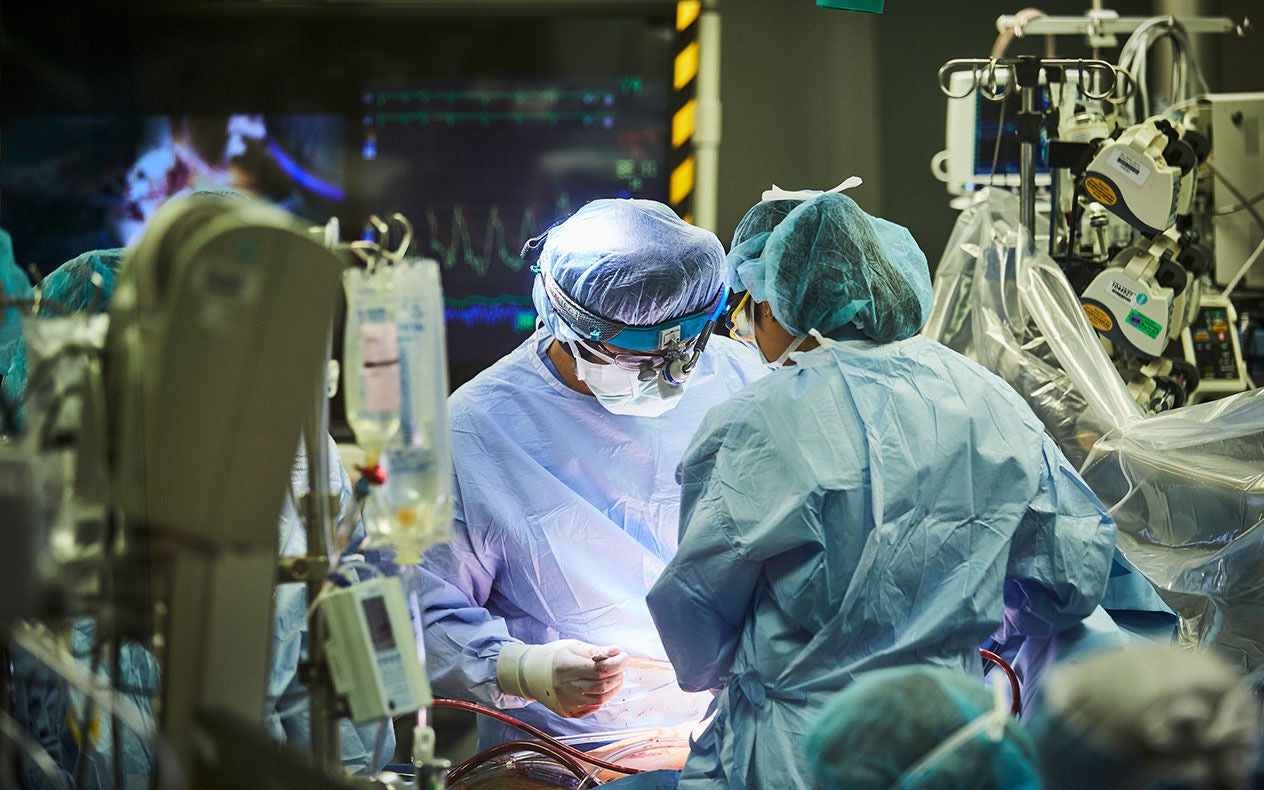
For patients with a tear in the lining of their aorta, the largest artery in the body, mortality is incredibly high — every hour that passes after an aortic dissection increases the risk of death.
To expedite access to lifesaving care, Cardiac Surgery and Vascular Surgery teams at Massachusetts General Hospital and Brigham and Women’s Hospital have mobilized a unified, multidisciplinary aortic team within Mass General Brigham’s Heart and Vascular Institute for the rapid evaluation, triage and transfer of all patients with acute aortic emergencies to one of the two world-leading academic medical centers.
“These are life or death situations, and there are not many places in our region and across New England that can manage them,” said Matthew Eagleton, MD, chief of Vascular Surgery for Mass General Brigham. “This approach gets patients with complex urgent and emergent aortic conditions into our academic medical centers in the shortest period of time.”
Referring physicians from hospitals throughout New England place a single call to Mass General Brigham’s Patient Transfer and Access Center to activate the on-call aortic team and initiate a transfer to Massachusetts General Hospital or Brigham and Women’s Hospital. The highly coordinated intake process typically takes eight minutes or less.
This efficient pathway from the emergency room to operating room (OR) or intensive care unit (ICU) puts patients in the capable hands of Mass General Brigham’s expert teams.
“Our multidisciplinary aortic program is the largest and most experienced in New England, and that means better outcomes for patients,” said Thor Sundt, MD, chief of Cardiac Surgery for Mass General Brigham. “Physicians who take care of aortic dissections routinely, as part of expert aortic dissection teams, have better results. Our experience matters.”
Two world-class hospitals, one team
Hospitals across the region and country are facing a capacity crisis, making it increasingly difficult for patients to access care. Mass General Brigham’s unified aortic team brings together the expertise and resources of our two academic medical centers to overcome capacity challenges, enabling communication across sites to ensure timely access to care for patients with aortic emergencies.
The streamlined process to accept a patient with an aortic dissection begins with a call to the Patient Transfer and Access Center, where a nurse gathers critical information and connects the referring physician to the on-call surgeon on Mass General Brigham’s aortic team. The surgeon reviews details of the case and directs the patient to the academic medical center with available OR or ICU capacity.
“Working as one team, we can say ‘yes’ (accept a transfer) to all patients with an aortic dissection and do so quicker than we ever have before. If one of our academic medical centers doesn’t have capacity, we have the flexibility in the moment to pivot to the other,” said Arminder Jassar, MBBS, cardiac surgeon on the aortic team. “This is a concrete example of the value of working together as a system and using our collective talent and resources to save lives.”
Unified, multidisciplinary care
Caring for a patient with an emergent aortic condition takes coordination — to enable timely access to an OR at Massachusetts General Hospital or Brigham and Women’s Hospital — and multidisciplinary collaboration that can involve colleagues across Cardiac and Vascular Surgery, Cardiology, Vascular Medicine, Nursing, Anesthesia, Perfusion and ICUs.
This collaboration was on display in January 2026, when a patient from a community outside Boston woke up with chest, jaw and abdominal pain, unable to move their left leg from the knee down. They were taken by ambulance to a local community hospital, where imaging revealed an aortic dissection that was preventing adequate blood flow from reaching their kidneys and left leg.
The community hospital called Mass General Brigham’s Patient Transfer and Access Center, who worked with the on-call aortic team to quickly coordinate a transfer directly into an operating room at Massachusetts General Hospital. Cardiac and vascular surgeons teamed up to perform the complex operation: Cardiac surgeon Antonia Kreso, MD, repaired the aorta and Eagleton restored blood flow to the legs and kidneys.
“Thanks to this rapid access to expert care, the patient was discharged home a week after the operation, able to walk independently with full function of both legs. Their kidney function also quickly improved and returned to normal,” Eagleton said.
But returning home after successful surgery did not mark the end of the patient’s journey with Mass General Brigham. The patient transitioned to outpatient care with cardiologist Eric Isselbacher, MD, MSc, who will support the long-term management of the patient to ensure the repaired aorta remains stable.
“These patients require ongoing follow-up care,” Isselbacher said, “and we are committed to providing the multidisciplinary support they need to optimize their recovery and maintain a healthy and active lifestyle.”