Detailed map from nearly one million heart cells offers insights into hypertrophic cardiomyopathy
Key takeaways
- Mass General Brigham researchers are part of an international team that has created a detailed molecular map of hypertrophic cardiomyopathy, a common form of heart disease
- Their findings identify biological pathways that could pave the way for more precise treatments
Adapted from a press release by the Max Delbrück Center
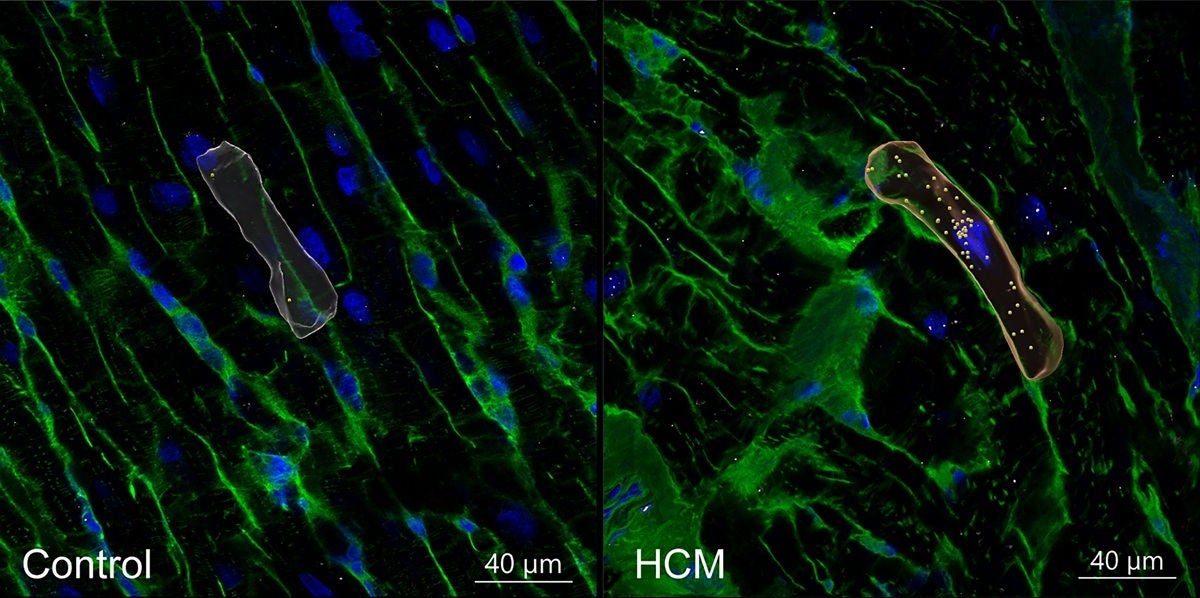
A team led by researchers from Mass General Brigham, Harvard Medical School, and Max Delbrück Center has illuminated the detailed molecular activity underlying hypertrophic cardiomyopathy (HCM), a common form of heart disease that causes the heart muscle to become thick and stiff. Their findings, published in Science Translational Medicine, demonstrate differences between genetic and non-genetic HCM as well as early and late-stage HCM.
“Charting the molecular landscape of hypertrophic cardiomyopathy is essential for advancing our understanding of the disease, improving patient care, and developing new therapeutic approaches,” said co-senior author Christine Seidman, MD, director of the Cardiovascular Genetics Program and a cardiovascular medicine specialist with the Mass General Brigham Heart and Vascular Institute. “By looking across nearly one million heart cells, we’ve gained important insights into molecular changes that underlie HCM.”
The study, co-led by Yuri Kim, MD, PhD, a principal investigator and cardiologist with the Mass General Brigham Heart and Vascular Institute, and Eleonora Adami, PhD, of the Hübner lab at the Max Delbrück Center, characterized the cellular and molecular signatures of HCM. The researchers used single-nucleus RNA sequencing to analyze heart tissue from 47 patients spanning early- to end-stage HCM, including people with genetic and non-genetic forms of the disease. The researchers then compared these gene expression profiles with data from healthy donor hearts and heart tissue affected by dilated cardiomyopathy, a condition in which the left ventricle balloons, thinning the chamber’s walls.
The team documented which genes were active in nearly one million individual heart cells. They created a comprehensive molecular map detailing altered gene activities according to stage of disease and genetic status.
They found marked differences between genetic and non-genetic HCM, with genetic HCM showing proportionally fewer heart muscle cells than non-genetic HCM and healthy donor tissue. The researchers also identified the gene PRR16 as a potential contributor to cardiomyocyte enlargement that is characteristic of HCM. Genetic HCM samples also had elevated expression of genes related to cardiac arrhythmias and fibrosis, features that contribute to disease progression.
The team also found distinct features for early-stage HCM. Fibroblasts — which produce and maintain the extracellular matrix that surrounds cells — expressed less collagen IV, a deficit that would likely destabilize the matrix.
In a final step, the team showed that an AI model trained on the gene expression data from heart muscle cells could accurately distinguish early from late-stage HCM, separate HCM from DCM, and correctly identify patients with genetic versus non-genetic HCM. Based on gene expression data from fibroblasts alone, the model was also able to make the same distinctions. “This was a surprising finding,” said Kim, “because cardiomyopathies are usually thought of as diseases of heart muscle cells only.”
These findings demonstrate that HCM caused by a genetic defect is distinct from non-genetic HCM. The molecular changes observed in HCM hearts from patients with a known genetic cause likely account for more arrhythmias and greater progression to heart failure.
“By mapping gene expression at single-cell resolution across disease stages and genetic subtypes, we've built a molecular signature of HCM's clinical spectrum,” Hübner adds. “This should provide a foundation for future work on more targeted treatments.”
Read the paper
Read the study in Science Translational Medicine
Authorship: This study was conducted as part of an international collaboration that included researchers at Mass General Brigham and Harvard Medical School (Seidman Lab, Kim Lab), Max Delbrück Center (Hübner Lab), Imperial College London (Noseda Lab), the University of Alberta (Oudit Lab), Helmholtz Munich, TU Munich (Heinig Lab), and Herz und Diabeteszentrum NRW (Milting Lab).
Disclosures: Seidman reports serving as scientific advisor for Maze and Tenaya Therapeutics and on the board of directors for Burroughs Wellcome Fund US and Merck. Additional author disclosures can be found in the paper.
Funding: This study was supported by The Beznos Family Fund; Boehringer Ingelheim Fonds; the British Heart Foundation (BBC/F/21/220106, FS/CRTF/23/24444, SP/19/1/34461, RE/18/4/34215, RE/24/130023); the British Heart Foundation Centre for Research Excellence, Imperial College London; the British Medical Association Foundation Josephine Lansdell Grant; the Deutsches Zentrum für Herz-Kreislauf-Forschung (German Center for Cardiovascular Research) (81Z0600106, 81Z0600105); the Canadian Institutes of Health Research (PJT-451105, PJT-462950); the Chan Zuckerberg Initiative (2019-002431, 2019-202666, 2021-237882); the Erich and Hanna Klessmann Foundation; the German Research Foundation (SFB-1470 Project B03); Imperial College Healthcare NHS Trust Biomedical Research Centre Funding (PA7460); the Medical Research Council UK; the NIHR Imperial Biomedical Research Centre; the National Science Foundation Engineering Research Center on Cellular Metamaterials (EEC-1647837); the Pathfinder Cardiogenomics Programme of the European Innovation Council of the European Union (DCM-NEXT, 101115416); the Rosetrees Trust (PGS23/100028); the Sir Jules Thorn Charitable Trust (21JTA); and the Wellcome Trust (226083/Z/22/Z).
Paper cited: Adami E and Kim Y et al. “Molecular Landscape of Hypertrophic Cardiomyopathy Across Disease Stages and Genotypes” Science Translational Medicine DOI: 10.1126/scitranslmed.aea2747
Media contact
Brandon Chase
Senior Specialist, External Communications
bchase7@mgb.org
About Mass General Brigham
Mass General Brigham is an integrated academic health care system, uniting great minds to solve the hardest problems in medicine for our communities and the world. Mass General Brigham connects a full continuum of care across a system of academic medical centers, community and specialty hospitals, a health insurance plan, physician networks, community health centers, home care, and long-term care services. Mass General Brigham is a nonprofit organization committed to patient care, research, teaching, and service to the community. In addition, Mass General Brigham is one of the nation’s leading biomedical research organizations with several Harvard Medical School teaching hospitals. For more information, please visit massgeneralbrigham.org.