Brain Computer Interface Clinic Highlights the Power of Collaboration
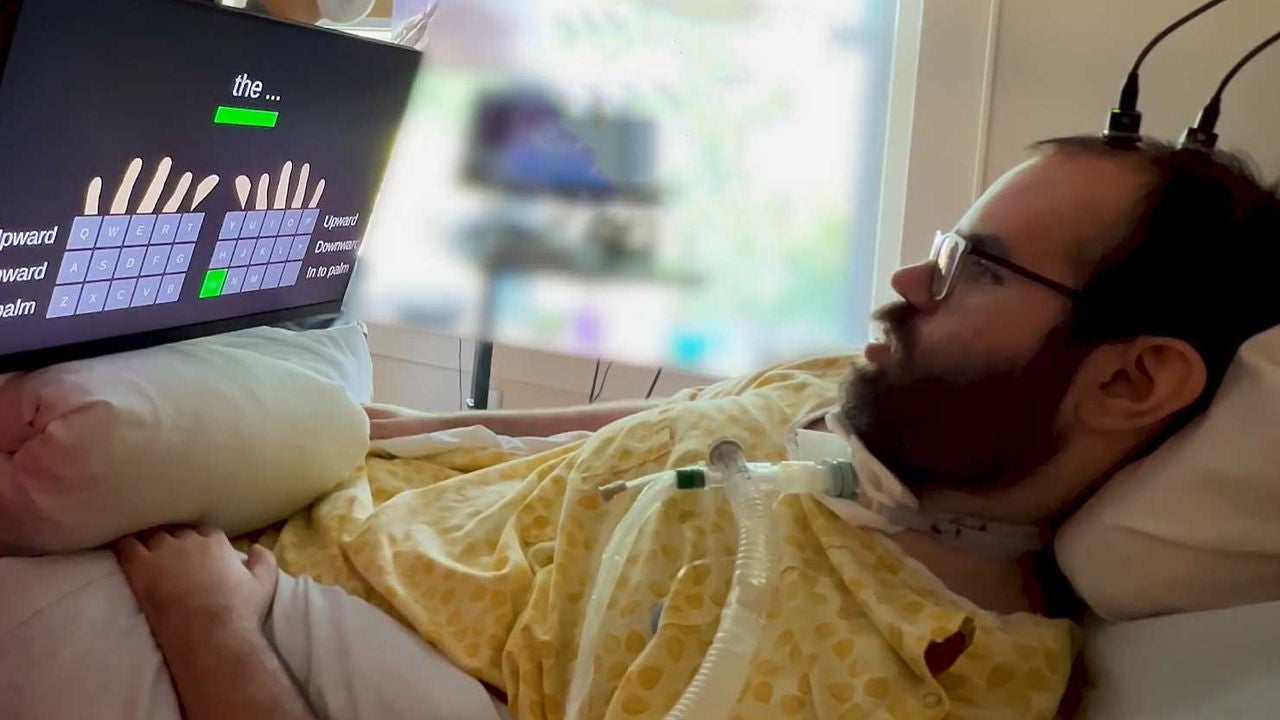
The Mass General Brigham Neuroscience Institute’s Brain-Computer Interface (BCI) Clinic collaboratively brings specialists in neurology, neurorecovery and functional neurosurgery together with researchers and neuroengineers from the Center for Neurotechnology and Neurorecovery to provide patients with access to the latest BCI technology, all with the goal of restoring patients’ function and independence.
What are implantable BCIs?
For patients with neurologic injuries or disease — such as spinal cord injury, stroke or amyotrophic lateral sclerosis (ALS) — an implantable BCI (iBCI) has the potential to restore and maintain communication, mobility and functional independence.
“iBCIs are systems that use recording electrodes placed into or onto a part of the brain that generates the intention for speech or movement. Neural signals are then transmitted to a computer where they are decoded and used to control assistive technologies such as computer cursors, keyboards, speech-generation software or robotic devices — all driven only by the user’s intent to move or intent to speak,” explained Leigh Hochberg, MD, PhD, leader of the BrainGate clinical trial and director of the Center for Neurotechnology and Neurorecovery.
Hochberg and his colleagues have been advancing the technology for more than 20 years, but now, bolstered by the support of the Mass General Brigham Neuroscience Institute, they are focused on accelerating their progress to bring the technology to more patients than ever before.
Multidisciplinary collaboration is key
“I often equate our work to summiting a mountain,” said Merit Cudkowicz, MD, MSC, executive director of the Mass General Brigham Neuroscience Institute, where she holds the Carol and James Herscot Endowed Neuroscience Institute Chair. “As we build and refine our institute, we must harness the power of our entire field, working together toward the same goal, to bring our vision for the future of neuroscience care and research to life. The BCI Clinic is a great example of how collaborative efforts across departments, disciplines and campuses can bring life-changing care to our patients.”
Hochberg says the Mass General Brigham Neuroscience Institute itself has helped enable the unique collaboration. “When the departments of Neurology and Neurosurgery united as one Mass General Brigham Neuroscience Institute, collaboration among colleagues investigating these neurotechnologies at both Massachusetts General Hospital and Brigham and Women’s Hospital became even more streamlined,” said Hochberg. “This work also benefits from the insights of our colleagues in Physical Medicine and Rehabilitation, Radiology and ENT (Ear, Nose and Throat). The institute structure has enabled us to design more efficient workflows, together, so that we can better serve our patients.”
Hochberg says the goal of the BCI Clinic is to provide patients and referring clinicians with a unified front door. “Patients come to the BCI Clinic from the Neurointensive Care Unit, from Mass General Brigham’s inpatient units and outpatient clinics, as well as Mass General Brigham’s rehabilitation services and other clinics. The BCI Clinic triages those referrals and provides access to our clinical expertise by getting the right patient to the right clinician and the right technology all at the right time,” he said.
The right technology for a given patient isn’t always an iBCI. Sometimes patients benefit from physical and occupational therapy, speech-language pathology or another neurotechnology-based treatment. In some cases, an iBCI or another clinical trial is the best option. The BCI Clinic functions as a hub to ensure each individual patient is evaluated for the treatment option that will best fit their unique needs.
Advancing the field
“Patients have been asking us for iBCIs for years,” said Hochberg.
By bringing together world leaders in the field and providing patients with the opportunity to enroll in exciting clinical trials, Hochberg believes that Mass General Brigham’s expertise will help to speed the availability of effective devices so that more patients can benefit from them.
“While the BCI Clinic is still young, I think it’s a model for what we are going to be able to do together throughout the Mass General Brigham Neuroscience Institute,” said Hochberg. “iBCIs are one of many technologies that are going to make a huge impact for our patients. There are many new clinical neurotechnologies in the pipeline, and Mass General Brigham is clearly the best place to lead across these closely aligned fields of neuromodulation, neurorecovery and neurotechnology.”
Cudkowicz added, “We have a vision for the Mass General Brigham Neuroscience Institute: to change the course of brain, spine and neuromuscular health worldwide through innovative science, bold collaboration and exceptional patient care. Rewriting the future so that, someday, all diseases within the neurosciences can be prevented or cured. What I see happening in the BCI Clinic truly exemplifies that vision. I hope it will serve as a model for our colleagues going forward.”