Research paves the way for blood-based heart diagnostics
Liquid biopsy developed by Mass General Brigham researchers for ‘cardiovesicles’ could spare patients from invasive biopsies
Research, co-led by investigators from the Mass General Brigham Heart and Vascular Institute, has shown a way to track molecular changes in the heart by isolating and characterizing what are known as cardiovesicles circulating in the blood. The findings, which are published in Cell, suggest a noninvasive way to monitor heart health and identify early signs of cardiovascular disease.
“Extracellular vesicles — membrane-bound particles that are secreted from cells and carry molecular cargo such as proteins, metabolites and RNA transcribed from expressed genes — can provide invaluable insights into what’s going on in any given cell,” explained co-senior author Saumya Das, MD, PhD, a physician-investigator with the Mass General Brigham Heart and Vascular Institute. “By studying those secreted by the heart’s muscle cells, or cardiomyocytes, we have developed a way to assess disease states from a tissue that cannot readily be sampled in patients.”
To isolate such cardiovesicles from the blood, Das and colleagues identified two surface markers (POPDC2 and CHRNE) present on heart cells and then used antibodies against these markers to isolate cardiovesicles from blood. When they analyzed the captured cardiovesicles from patients who had heart failure or had experienced heart attacks, the investigators found that the cardiovesicles contained RNA transcripts that reflected known disease-associated patterns.
Also, analyses of cardiovesicles during and after cardiopulmonary bypass surgery uncovered signs of dynamic cardiomyocyte stress responses in real time. In select cases where the team had access to heart biopsy tissue from patients with different heart conditions, cardiovesicle RNAs reflected these differences.
“Prospective studies can now test whether cardiovesicle RNAs can be used to track therapeutic response, identify different cardiovascular disease subtypes or anticipate disease progression,” said Das. “Extending our methods to other difficult-to-access organs could enable broader cell-type-specific liquid biopsy testing for numerous diseases.”
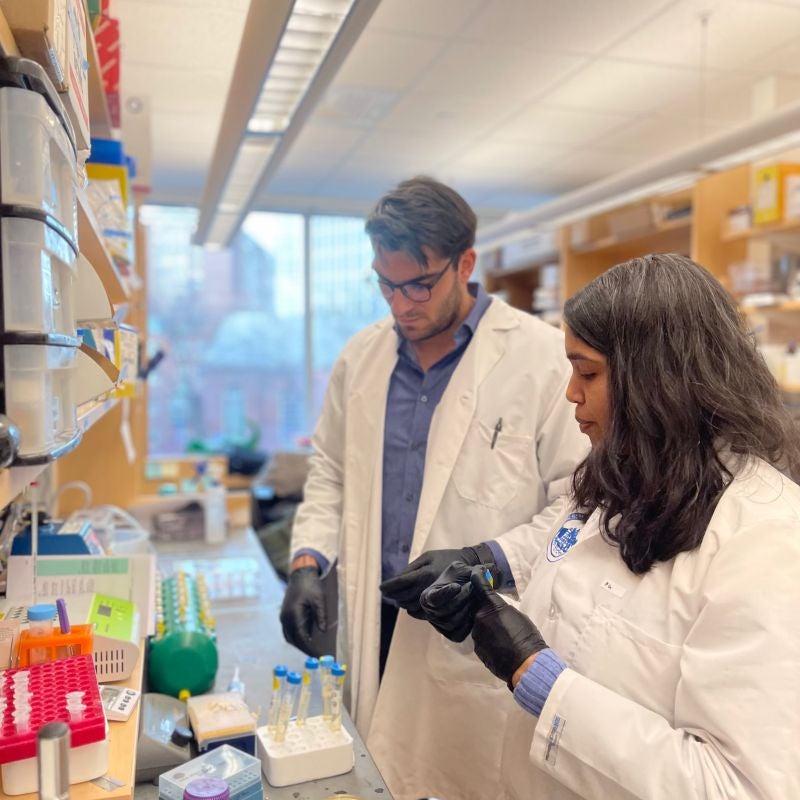
Priyanka Gokulnath, PhD, and Michail Spanos, MD, PhD, co-first authors of the study and members of the Das Lab within the Mass General Brigham Heart and Vascular Institute. Image credit: Eleftheria Karakatsina.
Read the paper
Cardiomyocyte-derived circulating extracellular vesicles enable a non-invasive liquid biopsy of human myocardium
Authorship: In addition to Das, Mass General Brigham authors include Priyanka Gokulnath, Michail Spanos, Emeli Chatterjee, Marta Garcia-Contreras, Natacha Carnel-Amar, Balazs Kazala, Claire Lin, Sary F. Aranki, Christopher Azzam, Parul Sahu, Christine E. Seidman, Patrick T. Ellinor, James L. Januzzi and Guoping Li. The study includes collaborators from Vanderbilt University Medical Center, the Translational Genomics Research Institute, City of Hope Comprehensive Cancer Center and other institutions.
Disclosures: Part of the study methodology is the subject of a provisional patent application, and patent holders may receive compensation under their institutions’ intellectual property policies if the technology is licensed. Saumya Das is a founder and equity holder in Thryv Therapeutics and Switch Therapeutics, neither of which participated in the study, and has received research grants from Bristol Myers Squibb, Cytokinetics and Abbott Laboratories for unrelated work. Ravi Shah has equity in and consults for Thryv Therapeutics and is a co-inventor on pending patents or disclosures related to cardiovascular disease, molecular biomarkers, RNA therapeutics and diagnostics and related methods. Additional authors report relationships with industry and/or intellectual property interests.
Funding: This study was funded in part by the National Institutes of Health (UG3/UH3TR002878, R35HL150807, R01HL150401, R01HL174709, R01HL164526, R01AG073633, R01HL151838, R01HG011138, R01GM140287, P30CA033572), American Heart Association (23POST1014230, 25CDA1452825, 23CDA1045944), Massachusetts General Hospital ECOR Fund for Medical Discovery (GR1000237), and the British Heart Foundation’s Big Beat Challenge award to CureHeart (BBC/F/21/220106).
Paper cited: Gokulnath P., et al. “Cardiomyocyte-derived circulating extracellular vesicles enable a non-invasive liquid biopsy of human myocardium.” Cell. DOI: 10.1016/j.cell.2026.10.050
Media contact
Brandon Chase
Senior Specialist, External Communications
bchase7@mgb.org
About Mass General Brigham
Mass General Brigham is an integrated academic health care system, uniting great minds to solve the hardest problems in medicine for our communities and the world. Mass General Brigham connects a full continuum of care across a system of academic medical centers, community and specialty hospitals, a health insurance plan, physician networks, community health centers, home care, and long-term care services. Mass General Brigham is a nonprofit organization committed to patient care, research, teaching, and service to the community. In addition, Mass General Brigham is one of the nation’s leading biomedical research organizations with several Harvard Medical School teaching hospitals. For more information, please visit massgeneralbrigham.org.